Neurodiversity-Affirming
MENTAL HEALTH COUNSELING & PLAY THERAPY
Wired differently, not deficiently.
Neurodivergent children communicate, connect, learn, and experience the world differently, not incorrectly.
Neurodiversity reflects the natural variation in how human brains develop and respond to the world.
These differences can bring valuable strengths as well as real challenges, particularly in environments that were not designed with diverse brains and bodies in mind.
Neurodivergent children do not need play therapy simply because their brains work differently.
They may benefit from therapy when they are experiencing:
Anxiety, overwhelm, or distress frequently
Emotion regulation challenges
Shutdowns, meltdowns, or burnout
Sensory-related distress
School stress or masking
Friendship and social challenges
Low confidence or feeling “different”
Parent–child conflict
Trauma, grief, or significant changes
Through a strengths-based, developmentally attuned, and neurodiversity-affirming approach, I help children:
Better understand and appreciate their unique ways of thinking, feeling, and processing.
Recognize their individual strengths and build self-confidence.
Develop more ways to communicate, regulate, and advocate for their needs.
Discover personalized accommodations and regulation strategies that work for them.
Strengthen their relationships and sense of safety, connection, and belonging.
Approach challenges with self-understanding and self-compassion rather than shame or pressure to conform.
Learn to work with, not against, their natural ways of experiencing the world.
The Therapeutic Relationship

Entering the child’s inner world.
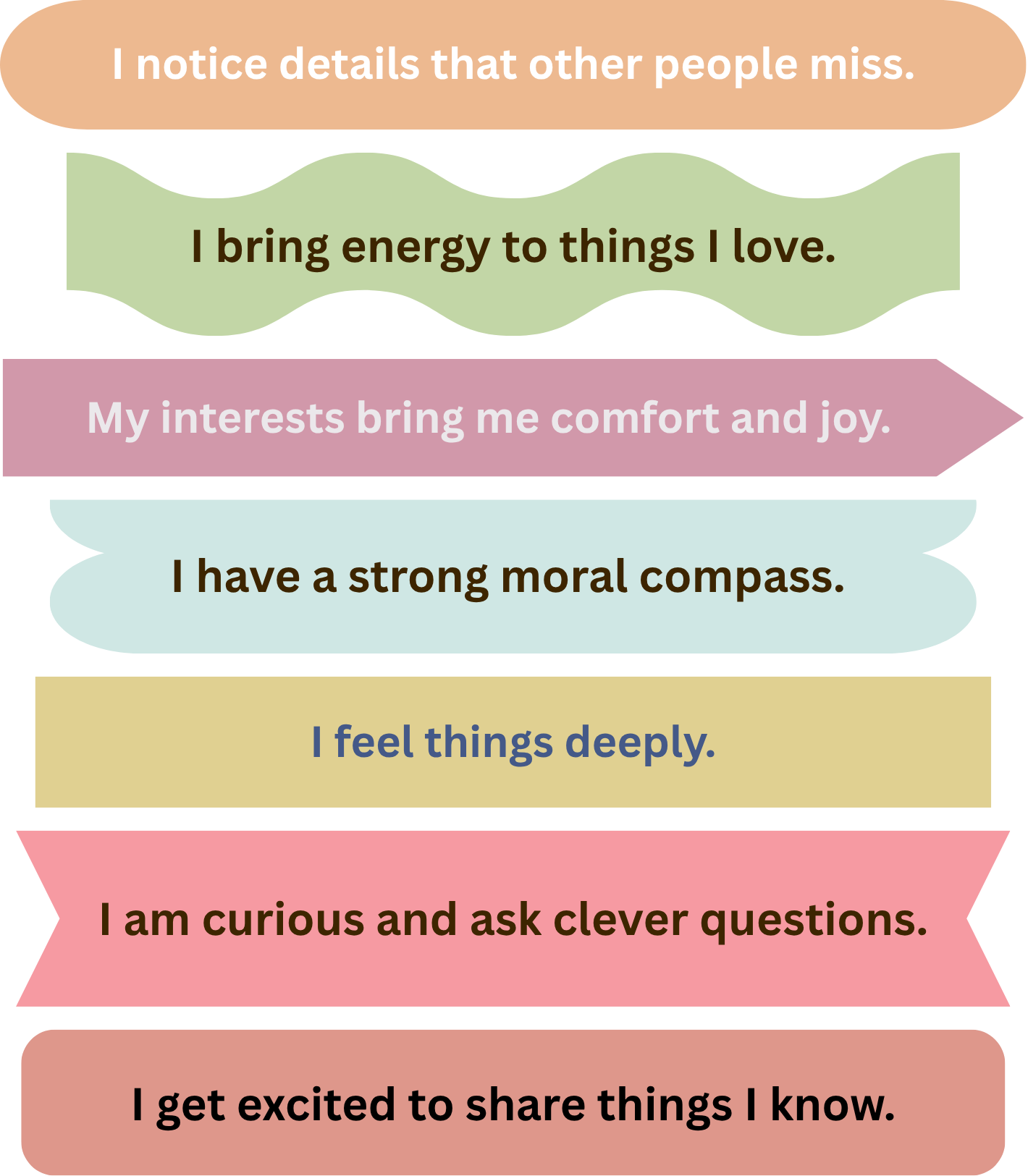
Neurodivergent children often have rich, absorbing inner worlds whose complexities remain largely invisible to adults. Connecting to this inner world is the foundation of secure attachment. It requires looking beyond outward behavior and approaching the child with genuine curiosity, openness, and patience.
In therapy, my role is not to pull the child away from their experience or press them to conform, but to connect with them exactly as they are. By following their lead, honoring their unique ways of communicating, and creating space for expression, I help the child feel seen, understood and safe. From that sense of safety, trust deepens, connection grows, and meaningful change becomes possible.
I WORK WITH CHILDREN OF ALL NEUROTYPES, INCLUDING:
Autism
ADHD, ADD
Dyslexia, Dysgraphia, Dyscalculia
Sensory processing differences
Communication differences
Neurotypical
NOT A ONE-SIZE-FITS-ALL APPROACH
By its very nature, my child-led approach naturally adapts to recognize & meet the unique needs of individual children.
1. tending to be different or develop in different directions; “divergent interpretations”
Synonyms: differing, varying, different, dissimilar, unlike, unalike, disparate, contrasting
di·ver·gent
Responsive to the neurodivergent experience:
I create a sensory-stable therapeutic environment.
I recognize and account for cross-neurotype differences in emotional experience and expression.
I help children connect bodily sensations with regulatory strategies, strengthening interoceptive awareness.
I supporting each child in developing a personalized vocabulary for identifying and communicating feelings.
(Daniel et al., 2026)
A growing awareness of your child’s neurodivergence can bring clarity, questions, and change. I’m passionate about helping families navigate what comes next with confidence and compassion.
Traditional medical models focus on symptoms, impairments, and “fixing” differences. While a diagnosis can provide valuable insight and access to support, this framework rarely offers families the full picture — it often overlooks personal strengths, identity, needs, and the unique implications of how they experience the world.
Your family deserves an approach that recognizes both the challenges and the beauty of neurodivergence and offers practical guidance for the journey ahead. I’m here to help.
Did your family recently receive a diagnosis?
QUESTIONS
-
No, your child does not need a formal diagnosis to access neurodiversity-affirming services. I support children based on their individual strengths, needs, and goals, regardless of whether they have a confirmed diagnosis, are awaiting evaluation, or have no diagnosis.
-
No, I do not provide formal evaluations.
-
Parents and caregivers are important partners in the therapeutic process. Your involvement will be tailored to your child’s age, needs, and goals and may include regular check-ins, collaboration, and practical strategies to support your child at home. Throughout the process, I also respect your child’s comfort, privacy, and autonomy.
-
Yes, with your written consent I can collaborate with your child’s school and providers to coordinate care, share relevant insight, and support consistency across environments.
-
Spoken language is not required for play therapy. I honor all forms of communication, including gestures, movement, play, facial expressions, behavior, and augmentative and alternative communication (AAC). Sessions are adapted to your child’s preferred ways of expressing themselves and connecting with others.
-
Rather than focusing on compliance or eliminating behaviors, I seek to understand what a child’s behavior may be communicating and address the underlying needs, emotions, sensory experiences, or environmental factors. Therapy supports regulation, communication, self-advocacy, and authentic connection while respecting each child’s autonomy.