PJ Johnson, M.A., M.Ed.
Licensed Professional Counselor Associate
Supervised by Brittany Jones, LPC-S, RPT-S
I specialize in Child-Centered Play Therapy and mental health counseling for children and adolescents. I am passionate about helping children and families navigate big emotions, challenging behavior, neurodivergence, and
the child-parent relationship.
After earning a Master’s degree in Special Education from The University of Texas at Austin, I spent several years supporting children and families in Austin ISD and other educational settings. My experiences in early childhood education, alongside meaningful exposure to families navigating childhood illness and loss, deepened my passion for understanding children's emotional worlds and supporting families through life's challenges.
This path led me to pursue a Master’s degree in Professional Counseling from Texas State University. My background in both education and counseling informs the way I approach therapy. Years spent studying child development, learning differences, behavior, family systems, and emotional growth have reinforced a belief that guides my work today: children do well when they can.
It is a privilege to walk alongside children and parents as they navigate difficult experiences, strengthen relationships, and discover new ways of understanding themselves and one another.
Born and raised in Austin, I am grateful to serve the children and families of the community that helped shape me. When I'm not in the playroom, I like to play outside. You can find me running around Town Lake or enjoying the Texas Hill Country with family and friends.
As a Licensed Professional Counselor Associate I have completed a Master’s degree in Professional Counseling and passed the state licensing exam (National Counselor Exam). I am in the process of completing my 3,000 supervised counseling hours to obtain full licensure. I am supervised by Brittany Jones, LPC-S, RPT-S.
Behavior…
we all do it.
Much of human behavior can be understood as an attempt to achieve one or more of four outcomes:
01 Gaining attention or connection
02 Avoiding or escaping a task, feeling, or setting
03 ACCESSING an item, activity, or experience
04 Meeting a sensory or PHYSIOLOGICAL need
Children communicate in many ways. When we pause to consider what a child may be experiencing or trying to communicate, their behavior often makes much more sense.
FLUCTUATING CAPACITY
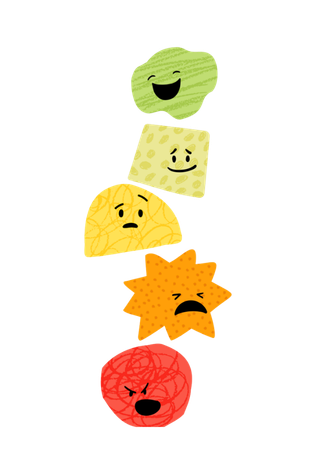
A child’s ability to make decisions and access skills depends on what’s going on in their nervous system.
Big emotions disrupt access to thinking and reasoning skills — survival mode takes over, the ‘thinking brain’ goes offline, and the body reacts as a stress response.
-
Big, physical reactions — Crying, screaming, hitting, running away, clinging to, or refusing — because they haven’t developed the language or regulation skills to explain what’s happening.
-
More behavioral and emotional reactions — arguing, yelling, getting stuck on fairness, saying “I don’t know,”, difficulty problem-solving, and struggling to follow familiar expectations — because these regulation/functioning skills are still developing to become readily accessible under stress.
-
More irritability, impulsivity, or withdrawal — snapping, shutting down, isolating, saying “I’m fine” or “I don’t care,” and struggling to think flexibly or communicate what’s actually going on — due to developing skills & intense emotions, social pressures, and drive for independence.
Too much or too little brain stimulation can impact a child’s ability to access skills like flexible thinking, communication, emotional expression, and impulse control in the moment. For neurodivergent children, whose nervous systems are already managing a lot, these fluctuations can be especially pronounced and disruptive. Grief, anxiety, trauma, transitions, relationship difficulties, and other stressors also influence a child’s capacity to cope, connect, and communicate.
Supporting development
When supporting a child, it helps to keep a larger goal in mind: to increase their capacity for regulation, communication, and connection so they have more options for responding.
It can be easy for parents to focus efforts and attention primarily on punishment as a negative consequence to undesirable behavior. While often well-intentioned, this approach can be counterproductive when it does not address what the child is experiencing or the need the behavior may be serving.
Punishment: A consequence that immediately follows a behavior and makes that behavior less likely to occur again.
At its most basic level, setting a limit and consistently maintaining it functions as punishment if it reduces a behavior. The goal of a limit is not merely to stop or restrict, it is also to help the child develop safer, more effective ways to express feelings, ask for support, tolerate distress, and access what they need.
THE THERAPEUTIC RELATIONSHIP
The therapeutic relationship supports this process by nurturing skills & capacities in the playroom, including emotional awareness, regulation and expression, impulse control, responding to limits, problem solving, empathy, bodily autonomy, identity and self-image, self-confidence, resilience, and relationship repair, among others.
Together, we develop child-counseling goals that are supported both inside and outside the playroom, helping new skills take root and carry across relationships, experiences, and environments.